Flagship AI apps vs. persistent tools
A few things clicked after spending an afternoon actually understanding the difference between flagship AI apps and persistent tools, not at a marketing level but at a "what is actually happening" level.
Contents
- The app/model distinction
- What "private by default" actually means
- Local tools as persistent coordinators
- You vs. the tool as the integration layer
- Hype is real, but early
The app/model distinction
Every major AI company runs two things simultaneously: a model and a consumer app. OpenAI makes GPT-4o (the model) and ChatGPT (the app). Anthropic makes Claude Sonnet/Opus (the models) and Claude.ai/Claude Code (the apps). Google makes Gemini (the model) and Gemini Studio (the app). These are separate things that happen to be bundled together, which matters when you're thinking about where your data goes, what you're paying for, and what you can swap out.
Some tools make this separation explicit because they have no model of their own. You bring your own model: your Anthropic API key, your OpenAI key, or a locally-running model. The tool just handles everything else.
What "private by default" actually means
This phrase gets thrown around a lot, so it's worth being precise.
When you use Claude, every message leaves your device, hits Anthropic's servers, the model runs there, and the response comes back. Your conversation history, your context, whatever you pasted in: all of that lives on Anthropic's infrastructure.
With a locally-running tool, the persistent state lives on your machine: your memory, preferences, credentials, history. That never leaves. The catch: when the tool actually generates a response, it still calls whatever model API you've configured. If that's Claude or GPT, your prompt does go to their servers at that moment. API calls generally have stronger data policies than consumer apps; Anthropic and OpenAI both commit to not training on API traffic by default, but it's not zero data leaving your machine.
The fully private path is running a local model (something like Llama or Kimi on your own hardware). Then nothing leaves your machine at any point, including during inference. Real tradeoff though: local model quality is still meaningfully behind the flagship models for most tasks.
Local tools as persistent coordinators
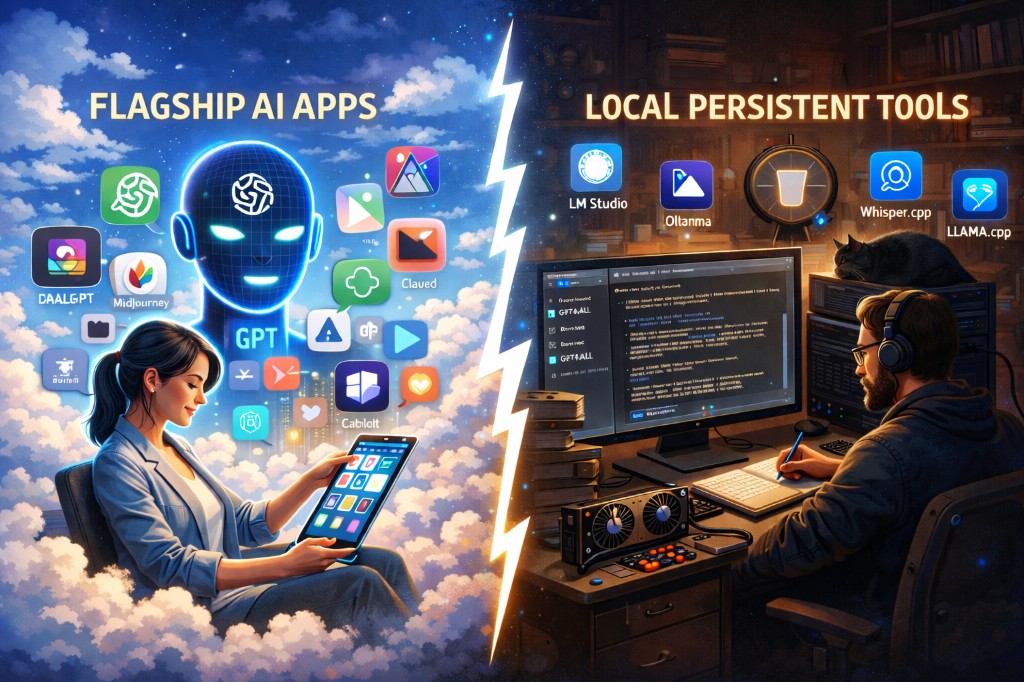
I initially misunderstood what it meant for a tool to "run on your machine." It sounds like you're doing heavy compute locally, but that's not really it. The inference is still outsourced to the model API. Your machine is running a lightweight process that does something the flagship apps can't: it stays on, has access to your local files and shell, runs background jobs, and maintains state across sessions.
The reason it runs locally isn't compute; it's access and persistence. It needs a foothold on your system to do things like check your email in the morning, run a cron job, or execute a shell command you asked for three days ago. The flagship apps can't do any of that because they have no presence on your machine between sessions.
You vs. the tool as the integration layer
Say you want AI to help manage your email.
With Claude or ChatGPT, you open the app, copy-paste emails in, ask for help drafting replies, copy the drafts back into Gmail, close the tab. Tomorrow you start over. You are the integration layer, manually moving context between systems.
With a persistent local tool, you onboard once with your preferences and Gmail access. Every morning it checks your inbox, drafts replies, and sends you a message asking if you want to send them. It remembers that you like warmer tones with recruiters. You're no longer in the loop for the routine parts.
The underlying AI inference is the same in both cases: a call to an LLM API. What's different is everything around that call (who holds the state, who initiates the action, and who has to manually bridge the gap between systems).
Hype is real, but early
Local persistent tools are genuinely interesting infrastructure. The self-extending skills system (where the tool can write and install its own new capabilities) is technically compelling. The messaging-channel interface removes real friction. And it all arrived at a moment when models are finally reliable enough for autonomous background agents to be trustworthy more often than not.
The flagship AI apps are optimized for conversations. Local persistent tools are optimized for tasks that happen whether or not you're actively talking to them. Those are different products solving different problems, and conflating them is why a lot of "AI assistant" discussions feel confused.